The rapid development of digital audio systems has led to a "democratization" of audio production technology, which until recently was only in the hands of professionals in the audiovisual field. Today, any amateur musician, with a small investment, can afford the luxury of having a small production studio at home to unleash their musical "perversions." Many of these musicians feel overwhelmed by the amount of technical concepts they now have to deal with, and some of them end up spending more time on technical audio aspects (mixing, mastering, compression, equalization...) than on what is really important (the musical piece itself).
We must not forget that anyone with a minimum of musical taste would prefer to listen to a good song with normal sound over a horrible song with excellent production. Therefore, it is counterproductive for a musician to become obsessed with issues that go beyond their functions. However, it is true that many of these musicians could achieve better quality in their productions by investing less time if they knew some basic concepts and procedures used by sound professionals. In this series of articles, we will try to shed some light on the mixing process, which, due to its complexity, is often where musicians feel most vulnerable.
What can we consider a good mix?
The mixing process, although it involves many technical aspects, can be considered a highly creative process. For this reason, determining whether a mix is good or bad depends on many entirely subjective factors. Sometimes we listen to a musical piece and think, "this sounds great," but many times, if asked why we like its sound, we wouldn't know what to answer.
Imagine two painters who have been academically trained in the same school and therefore both master the same techniques. If we placed a model in front of them and asked them to capture it on a canvas, the results could be very different. Something similar happens with mixes. If we asked two engineers to make a mix each of the same musical piece with the same equipment, two very different mixes could come out, even though it is understood that both engineers master all the techniques involved in the mixing process. It may happen that you think one mix is good and the other is bad, that both are good, that both are bad, ... or that one of them is simply perfect. Needless to say, another person will probably have a different opinion than yours.
The first step to achieving "the perfect mix" is to critically listen to a musical piece and analyze the way it was mixed. In this way, when you listen to a piece and like how it sounds, you will be able to know the reason why you like its sound, which will eventually allow you to see what you would like your mix to have. To conduct a critical analysis of a mix, we should listen to a musical piece focusing on some aspects of the mix.
First, we can observe the relationship between the levels of different elements. A mix must be coherent in levels since, for example, a rhythm guitar with a higher level than the main voice could ruin a mix. It should also be noted that sometimes we need to make a group of elements sound as a unit rather than as a sum of isolated elements, such as the elements of a drum kit. Therefore, for example, when deciding the level of the toms, we must base it on the level of the bass drum and snare.
Another very important aspect in a mix is the panorama. It is very important in a mix that each element is correctly placed in the stereo field. A widespread technique is to place low-frequency elements (bass drum and bass) and the most important elements (such as the main voice, solo instruments, snare...) in the center. Keep in mind that good panorama in a mix makes instruments sound clear. When we have an element that we cannot make heard clearly without extremely raising its level, probably, by adjusting the panorama and placing that element in an area where it is not hindered by other elements, we can make it heard clearly at a reasonable level.
Besides panorama, achieving clarity in elements of a mix significantly depends on attaining a good frequency balance. On one hand, a mix should ensure that every element has its own frequency space. As we will delve deeper into equalization later, when two elements share the same frequency range, one can become indistinguishable. Moreover, it's crucial to represent all audible frequencies (from 20Hz to 20kHz) in the mix to make the listening experience of the musical piece pleasant.
On the other hand, another fundamental element in a mix is the dimension. Dimension in a mix is achieved by adding effects like reverb, delays, flangers, etc. It's important to note that in most current productions (except symphonic, chamber, and choral music), the elements in the mix are recorded with close miking, which results in very little ambient influence from the room where it was recorded. Therefore, it's likely that you'll need to artificially add that ambiance during the mixing process. Additionally, most virtual instruments today will give you a sound lacking in ambiance.
At this point, it would be beneficial to listen to some music tracks you like on your monitors and try to analyze the mix based on the elements we've discussed (levels, panorama, frequency balance, and dimension). Remember, one of the best ways to learn mixing is by listening and analyzing many mixes, similar to what happens as a musician, where much of the music you know is owed to all the music you've listened to in your life. This will also help you get a true idea of how your monitors respond to commercial productions. Often, we sit in front of our monitors only to work and never really get to know how they truly respond. Listening to commercial music on the monitors you regularly work with will allow you to know when your work is straying too far from the "real world." A good solution to stay on the right track while working is to compile a collection of tracks from different musical styles on a series of CDs as a library. For instance, you can have a CD with rock tracks, another with flamenco tracks, another with electronic music tracks, etc. The purpose of this library isn't to try to copy the mix of any of the tracks, but to refresh your ears when you feel what you're doing might sound good because you've become accustomed to its sound. When you're not sure of your judgment, take a break and listen to some tracks from your library to refresh your ears.
But, what is a good mix? We can say a good mix is probably one that correctly gathers the characteristics we mentioned before (levels, panorama, frequency balance, and dimension). However, fulfilling these requirements only ensures that a mix is technically correct, which can be far from meaning a perfect mix. This is where the artistic part of the mixing process comes in. A good mixing engineer should know beforehand the direction they want to give to the sound of a musical piece before moving a single fader. Imagine we must mix a rock band and want the album's atmosphere to be very dense, which we could achieve by giving a "dirty" character to the sound. Making something technically sound good is not relatively difficult, as it only requires a set of technical knowledge. However, making a musical piece sound as it really should is not so easy. At first glance, we may think that "technically correct" mixes sound much better than other mixes that seek an artistic sense to the music's sound. For example, if we listen to albums like Radiohead's Kid A or Deep Purple's Rapture of the Deep, we can get an idea of all this (I recommend you try listening to some tracks from these two albums even if you don't like the musical style, as it can be very illustrative). These two albums could have sounded better technically, but no one can doubt that they are two albums mixed with great class and mastery. They could have sounded cleaner, clearer, had a better frequency balance, ... but that probably would have also ruined the magic that the mixes imprint on the music within them.
With all this, what we must understand is that a mix should always serve the music and not the person mixing. We should not hesitate to take risks and go the extra mile to make the music we're dealing with sound more interesting and exciting. Always keep in mind that when mixing, we should make the listener find what they hear interesting, not just be initially impressed by the sound and lose all interest after five minutes.
Therefore, we could say that a good mix is one that makes the music exciting and able to hold the listener's attention, even if it doesn't sound as technically correct as it could have been.
The Listening Environment
Before getting hands-on, there are several important issues that can simplify the mixing process.
First and foremost, we must pay attention to a crucial element in the mixing process that musicians often neglect: the monitoring system. Good mixing monitors can cost tens of thousands of euros, making them unattainable for non-professionals in musical production. However, there is a wide range of mid-range monitors on the market that can perfectly meet the demands of a home studio. Using a hi-fi monitoring system for mixing tasks is not advisable, as it won’t provide an accurate enough response and could ruin all our work.
Besides, to achieve an optimal mix, we need to work in an acoustically suitable environment (which can be quite costly). The monitoring system also includes the room where we work. Keep in mind that the sound coming out of the monitors will be heavily influenced by the room's acoustic response. For example, having expensive monitors with a good frequency response is useless if we sit down to mix in a room with a strong low-frequency reinforcement due to standing waves. If we mix under these conditions, our mixes will likely lack bass when played elsewhere. Although not the main focus of this article, improving the acoustic conditions of your mixing room is crucial.
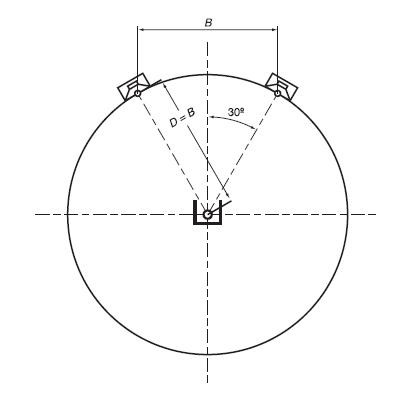
The placement of monitors is also very important. The most widespread recommendation comes from the ITU (International Telecommunication Union), stating that monitors should be placed at 60 degrees from the listening point, forming an equilateral triangle. This might sound complicated, but it's actually straightforward: the separation between the monitors should equal the distance from each monitor to the listening point, as shown in the figure.
Monitor Placement
Finding Order in Chaos
Before starting to equalize, compress, or perform any other mixing process, it's crucial to have a clear idea of what we aim to achieve and organize the work beforehand.
Top mixing engineers often confess that before they start touching anything, they always have a clear idea of what they want to achieve. To accomplish this, we must be familiar with the musical piece we're about to mix. If it's your own music, there's no issue, but if you're mixing something you've never heard before, the first step is to raise the level of all tracks and listen to the entire piece three or four times. It's helpful to take notes about strong and weak points of the piece, where to focus the listener's attention, possible effects that could work well, etc. Once this is done, you likely have a sound in mind for the final mix. Think of this stage as a block of clay for a sculptor: the sculptor must have an image of the figure they want to create in the clay before getting started. We have the clay and the image; now, during the mix, we will shape what we have in mind into the clay. It's often futile to start mixing without a clear plan, as we might reach a point of no return, forcing us to start the mix from scratch.
Once we are familiar with the piece, it's time to organize the mixing project so that everything is orderly and accessible when mixing. Remember, the mixing process is highly intuitive, and any delay in accessing what we want to see or modify can be detrimental, as ideas vanish as quickly as they come. A good starting point is creating a skeleton of the musical piece. Any sequencer will have options to memorize temporal points within the piece. It's convenient to divide the piece into different sections (verses, bridges, choruses, solos, etc.). This allows us to know where we are in the piece at all times and to access any point instantly.
Storyboard of the song El mundo al Revés by Lolaimon, from their second demo (Protools 7.1)
Another powerful tool to combat the chaos of a mix is using subgroups. Subgroups allow us to instantly mute or solo certain tracks. Typically, before starting the mix, I create subgroups for drums, guitars, pads, percussion, lead vocals, choirs, voices (lead vocals + choirs), rhythmic base (drums + bass + percussion), etc. Depending on the musical piece, we can make configurations as needed, always keeping in mind that we can create nested subgroups. During the mix, they allow us to process a set of tracks as a unit (e.g., compress all drum tracks together) and perform global automations (e.g., fade out the entire drum kit without needing to program the fade out on each drum track).
Each sequencer has its own peculiarities in terms of project organization, so it would be futile to describe each one here. The best approach is to investigate your sequencer’s manual and the information you can find on the Internet. You’ll see that it's a fairly straightforward topic that can significantly simplify your life.
How to Approach a Mix?
Alright. We have a piece to mix. We've listened to the piece. We've taken our notes. We've loaded all the tracks into our sequencer. We've organized the project. But... where do we start mixing? What's the logical order in which to do things? What philosophy should we follow when mixing?
As with almost everything in the world of mixing, there's no concrete answer. A good starting point is to see what should be avoided. The first thing you should avoid is thinking about the sound of different tracks individually. For instance, imagine you have to mix a typical pop band and you start by putting the kick drum track in solo, then equalizing and compressing it. Next, you mute the kick drum and solo the snare drum track, seeking a sound you like, then do the same for the other drum elements. Then, mute everything you've adjusted and solo the bass track, looking for a magnificent sound. Mute the bass and do the same with the guitars. And finally, focus on the vocal tracks. At first glance, this method may seem unproblematic, but in reality, we would be committing two very serious errors. First, having a good sound on all tracks individually doesn't ensure a good mix. In fact, I'd say the result could be so disastrous when played together that it would take less time to start the mix from the beginning than to readjust the sound of all tracks to work well together. Second, adding vocals last is a mistake. It's essential to remember that vocals are, like it or not, the most important element of a song, where the average listener will focus almost all their attention. When mixing, we must think that musical instruments serve to provide a good accompaniment for the vocals, not as leaders of the song (this applies to songs with vocals; in instrumental pieces, we'll usually have a main solo instrument serving as the vocal in terms of mixing).
So, it’s clear that the vocals (or main solo instruments) are the most crucial element we have, and what matters is the whole, not individual sounds. Don't be surprised if, after completing a mix and being amazed by how well the musical piece sounds, you solo a guitar track, for instance, and think, “Wow, that guitar sounds terrible!” Often when I have a client in the studio who isn't too accustomed to a mix, I try, as far as possible, not to leave any track soloed for fear of giving them a heart attack and not having to explain all this to them. This effect will be addressed later in this article when we delve deeper into equalization and dynamic processing.
A good starting point to find direction in a mix is to group all the tracks into structural elements of the musical piece. Think of a musical piece as composed of different elements, each with different importance and function. We can consider these structural elements as:
The rhythmic base, composed of the bass and percussive elements (drums, percussion, loops, electronic rhythms...)
The main instruments (lead vocals, lead guitar...)
Choral elements (choirs, guitar doubles...)
Supporting and contextual elements (rhythm guitars, keyboards...)
Ambiental elements (synthesizer pads, sound effects, string cushions...)
Each of these groups of elements has a very specific function within a mix, and we must keep this in mind to make the musical piece sound coherent. For example, it's pointless to have achieved a powerful rhythmic base and excellent sound effects when the vocals are camouflaged by those effects and the rhythm guitars don't create the right atmosphere because it's been ruined by giving too much presence to the rhythmic base.
Once we have in mind the structural elements that will compose a mix, we could already have an idea of how to approach our mix. However, it wouldn't hurt to know two of the most widespread ways of conducting a mix.
One approach involves starting with just one track and progressively adding the others. Where to begin varies greatly between personal tastes and the style of music. Some start with the kick drum, others with the overheads of the drums, others with vocals or main instruments... Personally, I prefer to start by making the lower part of the mix consistent. I raise only the kick drum track, search for the sound I have in mind, then, while listening to the processed kick drum, I raise the bass track and equalize and compress until I see both tracks work well together and serve the objectives of the sound I'm looking for in the piece. Then I add the snare, process it, and add the vocals afterward. Once these tracks work well together, I progressively add the other elements, although the order often varies depending on the musical style and the piece I'm dealing with. It's crucial to keep in mind that as you add tracks, you must constantly go back and readjust previously added tracks to ensure the whole set sounds as you want. What I would like to emphasize is not to leave vocals or main instruments for last, as this will help you avoid problems in properly situating them within the mix.
The other mixing approach, also widely used, is to raise all tracks at once and start working from there. With this method, a mono mix is initially made using only the levels of the tracks. Then, the elements are positioned in the stereo field using the panorama controls. From there, each person follows their instincts until achieving the desired sound for the musical piece.
There can be countless ways to mix. As you do more and more mixes, you end up adopting your own personal style.
As you can see, a mix involves much more than just equalizing, compressing, gating... It's important that you have clear everything we've discussed in this part of the article before starting to touch knobs, buttons, and other paraphernalia. We'll leave all those matters for later in the article.